In this research dossier, we will delve into the fascinating world of symbolism and it’s importance in the rich history of tattoo design. Symbolism has been an important aspect in all areas of design over the ages from graphic design to illustration, and in recent years (as tattooing has risen in popularity) we ask what place symbolism has in modern and ancient practises of tattoo art.
Charles Peirce defines a symbol as an image we attach meaning to – whether this is through a collective historical or religious context or “our framework of knowledge which helps us understand the meaning of these signs”(Peirce, 1991) For example, a cross will be understood by the majority of people as a symbol of Christianity.
The symbolism movement of the 19th century was initially a European literary movement which became equally as significant in art. Symbolism was an attempt to move away from the more literal and realistic and instead into a more imaginative and mythological art form. The symbolists would use metaphorical imagery and symbols to create works of art, often gravitating towards the macabre, supernatural and sexual, perhaps due to the societal troubles of the victorian era. One could argue that symbols have always been a key aspect of human communication and expression “Human beings communicate through art with symbols that transcend the boundaries of time and culture” (Clar, 1993)
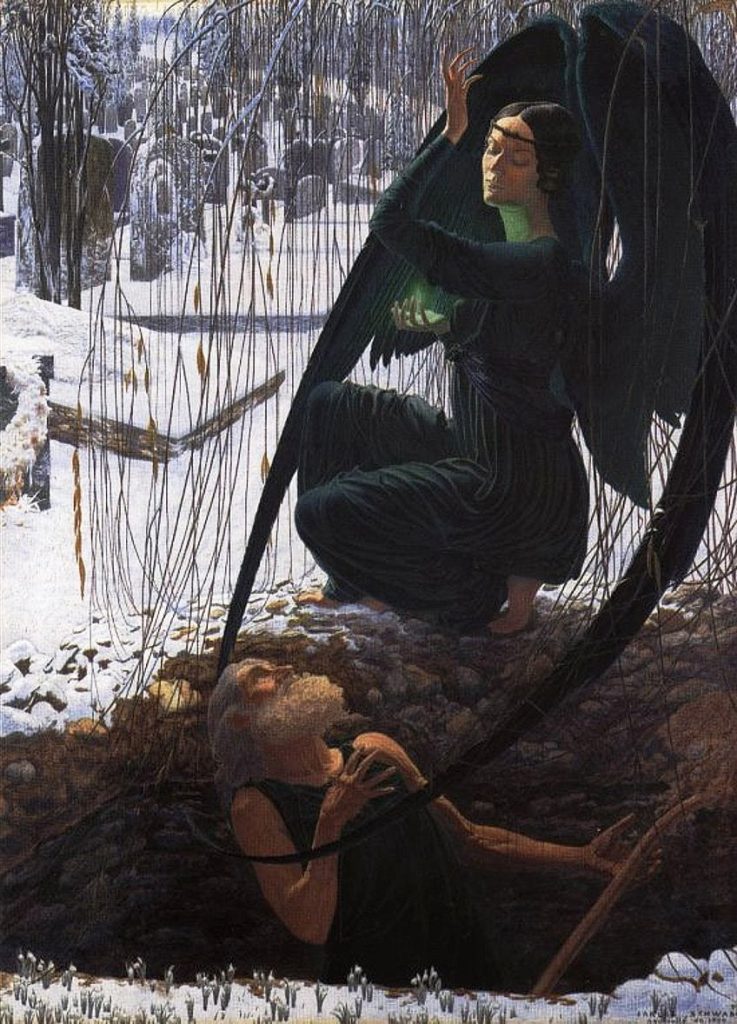
When we look at Tattooing as an art form, we discover a history and culture larger than one may initially think. Tattooing is often regarded as a taboo and darker art with not many people recognising tattoo design as being so complicated, symbolic and intricate. In this project, I will combine these darker design themes, with the mystical symbolism movement to create and execute a portfolio of symbolic tattoo designs.
REFERENCES:
Clar, R. (1993) An Art-and-Technology Payload for the Space Shuttle. Leonardo, 26 (Nr.4), 293-296
Peirce, C. (1991) Peirce on Signs: Writings on Semiotic. University of North Carolina Press.
Schwabe, C. (1890?) Death and the Grave Digger (Painting). Musee du Louvre, Paris.