Tufte’s theory of micro-macrocosms suggests that an important part of visual design is having an other meaning created by a make up of smaller micro visuals which could also be seen to have their own meaning (Tufte 1990, pp.37-53). I will be exploring this theory in relation to my chosen subject of magazine design.
Magazines in general are often seen as stand alone items with no larger meaning, however individual magazines could also be seen as individual micros that represent a larger brand. For example this magazine ‘Animal Planet’ is an educational magazine series for children however Animal Planet also produce other content for television, social media and online streaming services. You could therefore see this magazine as a microcosm for the macrocosm: the larger brand. This magazine cover uses layers of text and image to illustrate the content within the magazine. This effectively shows the viewer that this magazine is about animals and therefore the brand producing the magazine makes content about animals.
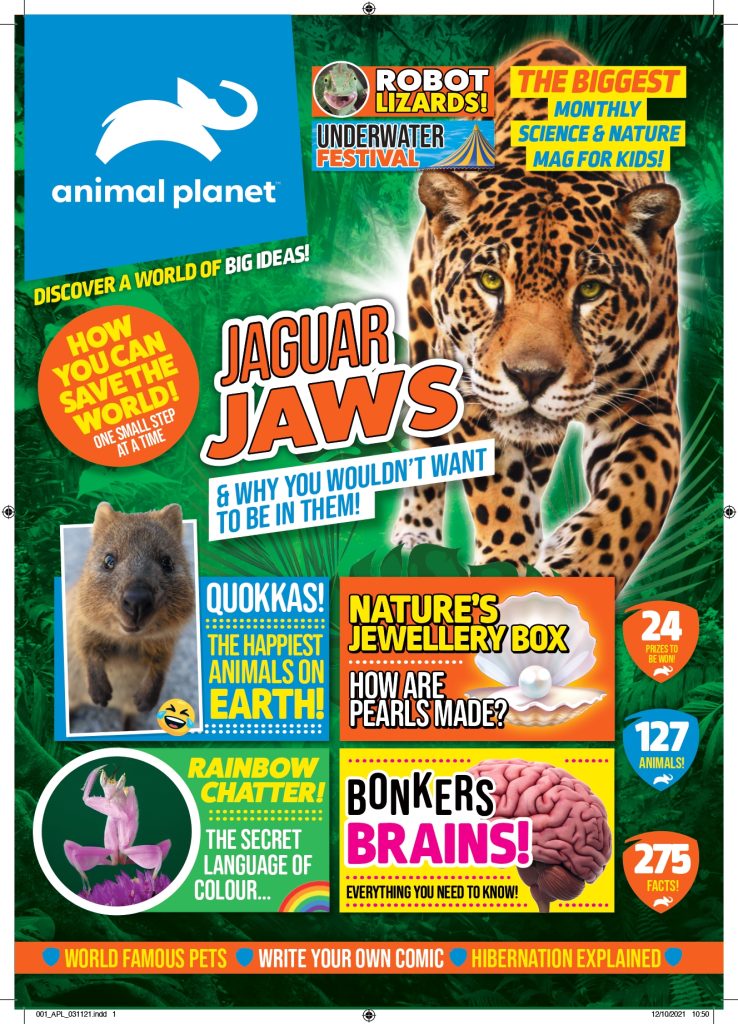
Another way of looking at micro-macros in magazines could be to see each individual magazine as a micro of a large course that is built upon when other magazine issues are collected. Magazines are a good way of breaking down a large educational course into separate micro parts, this is because the viewer should not be overloaded with a multitude of information at once and instead, it is more effective to focus on one thing at a time. Tom Wilson writes that “As briefly as I can put it, we shouldn’t give our students too much information at once.” (Wilson, 2015). Magazines are the perfect opportunity to break down information as they offer an easier and more visually appealing way to learn.
References:
Animal Planet, 2021. Subscribe to Animal Planet magazine! (Online Purchase) [Online] (Updated ? 2021) Available at: https://www.animalplanetmagazine.com/subscribe/ [Accessed 15 November 2021]
Tom Wilson, 2015. How to avoid cognitive overload in the classroom. (Article) [Online] (Updated 6 March 2015) Available at: https://edu.rsc.org/analysis/how-to-avoid-cognitive-overload-in-the-classroom/2010107.article [Accessed 15 November 2021]
Tufte, E.R., 1990. Envisioning Information. Cheshire (CT): Graphics Press.